
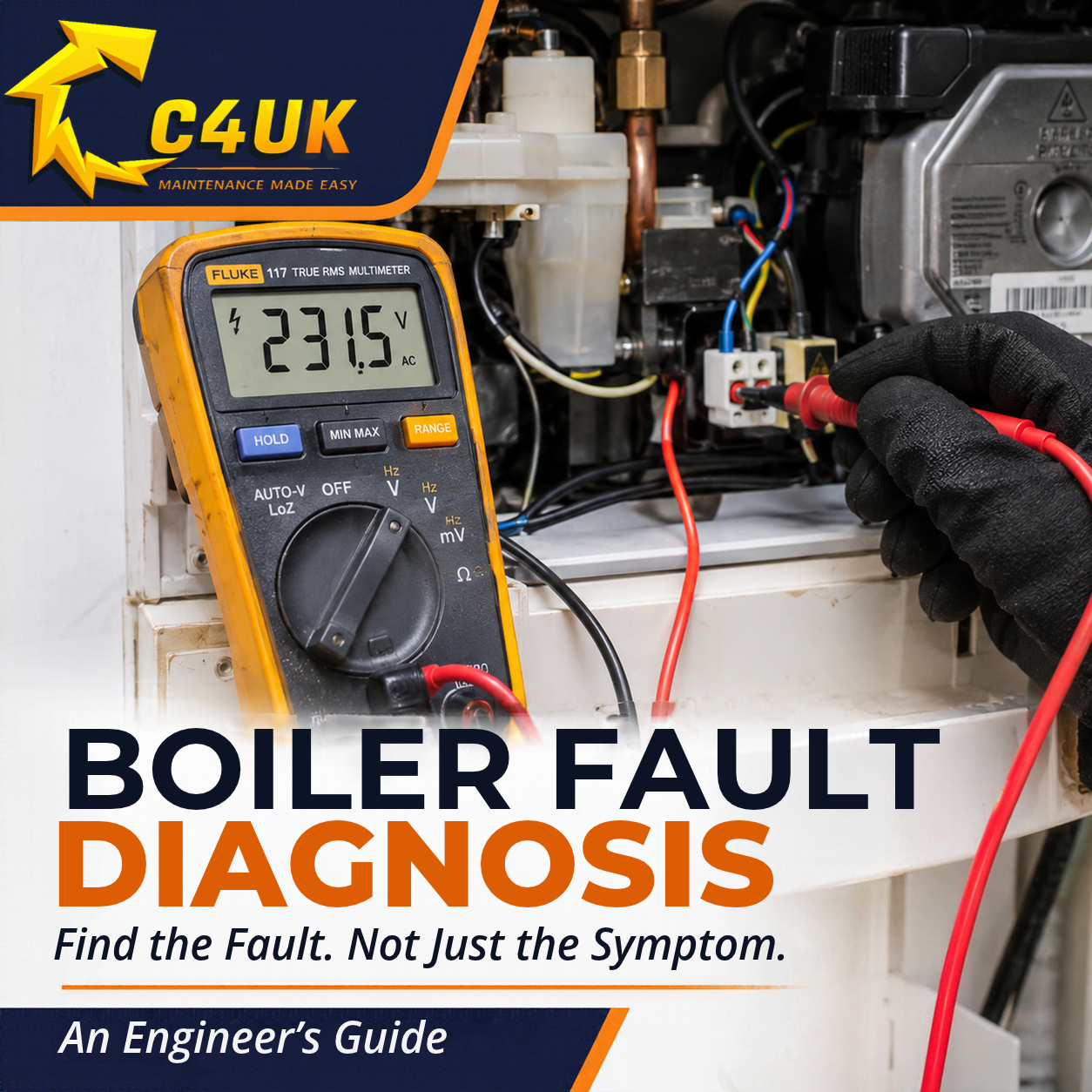
When your boiler stops working, the first question is usually simple: What’s wrong, and how much will it cost to fix?
Boiler fault diagnosis is about finding the actual cause of a problem rather than replacing parts and hoping for the best.
As heating engineers, we regularly come across boilers that have stopped producing hot water, won’t ignite, keep switching off or display a fault code. Sometimes the problem is a failed component. Other times, the boiler is simply responding to another fault somewhere in the system.
At Certificates4UK Ltd, we believe that good fault finding starts with understanding how the boiler works, checking the basics and testing the right components in the right order.
In this guide, we’ll explain how professional boiler diagnostics work, what engineers look for and why electrical testing plays such an important role.
What Is Boiler Fault Diagnosis?
Boiler fault diagnosis is the process of identifying why a heating appliance isn’t operating correctly.
Modern boilers contain several electrical and mechanical components that must work together. These include sensors, pumps, fans, ignition systems, safety devices and electronic controls.
When one component stops working, the boiler may shut down to protect itself.
However, the component that appears to have failed isn’t always responsible for the original problem.
For example, a boiler may display an ignition fault because it cannot establish a flame. That doesn’t automatically mean the ignition electrode needs replacing.
The engineer needs to investigate what happened before the fault occurred.
That’s the difference between guessing and diagnosing.
Why Boiler Fault Diagnosis Starts With Safety
Before testing any boiler, a qualified engineer needs to establish that the appliance is safe to inspect.
A boiler combines gas, electricity, water and combustion. Each presents different risks.
Our first checks consider the condition of the appliance, any obvious signs of damage, electrical safety and whether there are indications of an unsafe gas installation.
Electrical isolation is especially important.
Simply turning off a boiler at its control panel doesn’t necessarily isolate the electrical supply.
Before carrying out work on electrical components, engineers must follow appropriate safe-isolation procedures and verify that the relevant circuits are dead using suitable equipment.
Engineer’s advice: Never assume a boiler is electrically isolated just because its display has switched off.
Gas appliance work and internal boiler diagnostics should be undertaken by engineers who are competent and appropriately Gas Safe registered for the work involved.
How Engineers Diagnose Common Boiler Faults
There is a logical sequence to diagnosing most boiler problems.
Rather than immediately opening the appliance and changing components, we start by understanding the symptoms.
Step 1: Understand What the Boiler Is Doing
One of the most useful parts of any repair visit is speaking to the customer.
We might ask:
- Does the boiler fail every time or only occasionally?
- Is the problem affecting heating, hot water or both?
- Does the boiler attempt to start?
- Is there a fault code on the display?
- Has the system pressure been dropping?
- Did the problem begin after any recent work?
These questions help narrow down the possible causes.
For example, a boiler that provides heating but no hot water may require a different investigation from one that won’t ignite at all.
Step 2: Check the Basic Operating Conditions
Before suspecting an expensive component, we establish whether the boiler has the conditions needed to operate.
Depending on the symptoms, this can include checking the electrical supply, system water pressure, heating controls and relevant gas supply conditions.
A boiler cannot operate correctly if an essential supply or safety condition is missing.
Sometimes these basic checks identify the problem without extensive dismantling.
Step 3: Understand the Boiler’s Start-Up Sequence
This is one of the most important principles of professional boiler fault diagnosis.
A boiler follows a sequence when it receives a request for heating or hot water.
Although the exact sequence varies between models, a modern boiler may need to:
- Recognise a heating or hot water demand.
- Confirm the relevant safety conditions.
- Operate the circulation pump and fan as required.
- Establish the necessary ignition conditions.
- Ignite the burner.
- Confirm that a flame has been established.
- Adjust its output to maintain the required temperature.
If the sequence stops, the engineer investigates that stage and the conditions required for it to continue.
For example, if the fan doesn’t start, there is little value in immediately replacing the ignition electrode.
The problem may be earlier in the operating sequence.
Engineer’s tip: Find the point where the boiler stops doing what it should. That usually tells you where to investigate next.
Boiler Multimeter Testing: What Does It Tell Us?
A multimeter is one of the most useful diagnostic tools in an engineer’s toolkit.
It helps us investigate electrical faults by measuring quantities such as voltage, resistance and continuity.
Each measurement answers a different question.
| Test | What it tells the engineer |
|---|---|
| Voltage | Whether the expected electrical supply or control signal is present |
| Resistance | Whether a component’s electrical resistance is within the expected range |
| Continuity | Whether an appropriate electrical path is complete |
| Current | How much electrical current a component is drawing, using suitable test equipment |
These tests help engineers decide whether a component is faulty or whether the problem lies elsewhere.
However, a meter reading must always be compared with the manufacturer’s specifications and the conditions under which the test was taken.
A component shouldn’t be condemned on the basis of one reading alone.
Common Boiler Electrical Faults
Electrical problems can produce symptoms that look very similar to mechanical faults.
Here are some examples we regularly investigate.
1. Faulty Boiler Thermistors
A thermistor is a temperature sensor.
It tells the boiler’s control system how hot the water is.
Most boiler temperature thermistors change resistance as their temperature changes.
If a thermistor gives an incorrect reading, the boiler may respond as though the water is hotter or colder than it really is.
Possible symptoms include:
- Inconsistent hot water temperatures
- Heating performance problems
- Temperature-related fault codes
- Unexpected boiler shutdowns
During diagnosis, an engineer can compare the thermistor’s resistance with the manufacturer’s temperature and resistance information.
A faulty reading may indicate a damaged sensor, although wiring and connections must also be considered.
2. Boiler Pump Problems
The circulation pump moves heated water around the heating system.
If the pump fails or cannot circulate water correctly, the boiler may overheat, shut down or fail to heat the radiators properly.
A pump problem doesn’t always mean the motor has failed.
Possible causes include electrical supply problems, a seized mechanism, air in the system or restricted circulation.
Engineers investigate the electrical and hydraulic conditions before deciding whether replacement is necessary.
3. Boiler Fan Faults
The fan plays an important role in the combustion process.
If it fails to operate correctly, the boiler may be unable to proceed safely with ignition.
A fan fault could involve the motor, wiring, electronic controls or another condition affecting operation.
An engineer needs to establish whether the fan is receiving the correct control and electrical inputs before deciding that the fan itself has failed.
4. Ignition and Flame Detection Problems
A boiler may attempt to ignite but fail to establish a stable flame.
Possible causes include:
- Ignition electrode problems
- Damaged ignition leads
- Spark generator faults
- Gas supply or combustion issues
- Flame detection problems
- Electrical control faults
These symptoms can overlap.
That’s why replacing an ignition electrode without checking the surrounding system isn’t always the right solution.
5. Faulty Boiler Switches and Sensors
Boilers use various switches and sensors to monitor operating conditions.
Some operate by opening or closing an electrical circuit. Others produce changing resistance or electronic signals.
A faulty switch or sensor can prevent the boiler from completing its normal operating sequence.
An engineer uses the appliance’s service information to establish how the component should behave and whether it is operating correctly.
Understanding Resistance and Continuity Tests
Resistance and continuity are related, but they don’t tell us the same thing.
A continuity test checks whether an electrical path is complete.
For example, a suitable switch may show an open circuit in one position and a closed circuit in another.
A resistance test measures how strongly a component opposes electrical current.
This is particularly useful when checking components such as thermistors and certain motor windings.
However, a component can show electrical continuity and still be mechanically defective or fail during normal operation.
Important: Resistance and continuity measurements must only be performed on appropriately isolated, de-energised circuits, following the relevant testing procedure.
Why Boiler Fault Codes Don’t Always Identify the Failed Part
Modern boilers display fault codes to help engineers understand why an appliance has stopped.
These codes are useful, but they are not always a direct instruction to replace a particular component.
For example, an ignition-related code tells us that the boiler has experienced a problem establishing or maintaining combustion.
It doesn’t necessarily identify the underlying cause.
The same applies to circulation, temperature and fan-related faults.
We use fault codes as a starting point, then investigate the operating conditions and components involved.
A proper boiler fault diagnosis combines the displayed information with physical inspection, measurements and knowledge of the boiler’s operating sequence.
Common Boiler Symptoms and Possible Causes
| Boiler symptom | Possible causes | What an engineer investigates |
|---|---|---|
| Boiler won’t ignite | Ignition system, gas supply or control fault | Start-up sequence and ignition conditions |
| No heating | Pump, controls, circulation or diverter issue | Heating demand and water circulation |
| No hot water | Flow sensor, diverter valve or heat transfer problem | Hot water demand and operating response |
| Boiler keeps switching off | Overheating, pressure, sensor or combustion issue | Fault history and safety conditions |
| Fan not operating | Fan motor, wiring or control fault | Fan operating conditions and electrical inputs |
| Water temperature fluctuates | Sensor, flow or heat transfer problem | Temperature readings and system performance |
| Boiler loses pressure | Leak, expansion vessel or pressure-related issue | System pressure and water-side components |
These are possible causes, not confirmed diagnoses. Several faults can produce the same symptoms.
Why Replacing Boiler Parts Without Testing Can Cost More
Imagine a boiler that isn’t producing hot water.
Someone assumes the diverter valve is faulty and replaces it.
The problem remains.
Next, they replace a sensor. Still no improvement.
Eventually, the actual issue is found in the hot water demand detection system.
The customer has now paid for unnecessary components and additional labour.
This is exactly why we favour systematic fault finding.
A proper diagnosis may take some time, particularly when dealing with intermittent faults. However, it helps avoid unnecessary replacement work and gives the customer a clearer explanation of the repair.
Good engineering isn’t about changing the most parts. It’s about identifying the actual problem.
When Should You Call a Gas Safe Engineer?
Some boiler problems can be checked by a homeowner without opening the appliance.
For example, you can refer to your user manual to check whether the thermostat is calling for heat, whether the boiler displays a fault code or whether the system pressure is within the manufacturer’s recommended range.
However, you should arrange professional assistance if:
- The boiler repeatedly locks out.
- Hot water or heating becomes unreliable.
- The appliance makes unusual noises.
- The system repeatedly loses pressure.
- An ignition or combustion fault appears.
- The boiler has an electrical problem.
- The appliance has been identified as unsafe.
Never remove combustion-related covers, bypass safety devices or attempt internal electrical testing yourself.
If you smell gas, follow the emergency gas safety procedure and contact the National Gas Emergency Service on 0800 111 999 from a safe location.
Professional Boiler Fault Diagnosis in Surrey
At Certificates4UK Ltd, we’ve been providing property maintenance and gas services since 2011.
Our Gas Safe registered engineers investigate boiler faults using a systematic approach, starting with the symptoms and working through the relevant operating conditions.
We regularly assist homeowners and landlords in West Molesey, East Molesey, Walton-on-Thames, Esher, Weybridge, Hersham, Thames Ditton and Kingston upon Thames.
We also cover surrounding areas of Surrey, including Cobham, Claygate and Surbiton.
Whether your boiler won’t ignite, keeps switching off or isn’t producing reliable hot water, the first step is understanding why.
For more information about our services, visit our gas and boiler services page.
You can also read our related technical guides covering:
- Ideal boiler ignition faults and spark generator testing
- Intermittent hot water and flow turbine problems
- Worcester Greenstar CDI poor hot water diagnosis
- Boiler thermistor testing
- Boiler pump fault diagnosis
Frequently Asked Questions About Boiler Fault Diagnosis
What is boiler fault diagnosis?
Boiler fault diagnosis is the process of investigating why a boiler isn’t operating correctly. Engineers examine symptoms, operating conditions, fault codes and relevant components to identify the underlying problem.
Can a multimeter identify a faulty boiler component?
A multimeter can help identify electrical problems by measuring voltage, resistance and continuity. However, readings must be interpreted correctly and compared with the manufacturer’s specifications.
Why does my boiler keep locking out?
Repeated lockouts can be caused by ignition faults, overheating, pressure problems, sensor faults or other safety-related conditions. A professional inspection is needed to establish the cause.
Does a boiler fault code mean a component needs replacing?
Not necessarily. A fault code identifies a detected problem or operating condition, but the underlying cause may involve another component or system.
Can a boiler be repaired without replacing parts?
Yes. Some faults can be resolved by correcting settings, addressing system conditions or repairing a suitable connection. Other problems require component replacement. The correct approach depends on the diagnosis.
How long does boiler fault diagnosis take?
Simple faults may be identified relatively quickly. Intermittent or complex problems can take longer because engineers may need to observe several operating cycles and carry out additional tests.
Can I test my boiler with a multimeter myself?
Homeowners should not attempt internal electrical testing. Boilers contain potentially dangerous electrical and combustion components. Testing should be carried out by a competent professional.
Is a boiler service the same as boiler fault diagnosis?
No. A boiler service is routine maintenance and safety checking, while fault diagnosis investigates a particular problem. Both are important, but they serve different purposes.
Final Thoughts
Boiler fault diagnosis isn’t about finding the first component that looks suspicious.
It’s about understanding how the boiler should operate, identifying where the process is failing and using the correct tests to confirm the cause.
From our experience, the best repairs usually start with the simplest question:
What should the boiler be doing at this point, and why isn’t it doing it?
That approach helps engineers make better decisions and gives homeowners a clearer understanding of what they’re paying for.
Related Services
- Gas Safety Certificate (CP12)
- Boiler Servicing Surrey
- Boiler Repairs Surrey
- The Energy Performance Certificate (EPC)
- The Electrical Installation Condition Report (EICR)
Useful links
Contact Certificates4UK Ltd
Need a reliable Gas Safe engineer for boiler repairs, safety checks, or certification? We’re here to help.
We cover:
Molesey • Walton • Woking • Cobham• Weybridge • Sunbury-on-Thames • Surrey • London
Before replacing any parts or booking costly work, let one of our qualified engineers carry out a professional inspection to save you time and money.
Booking Options:
- 🌐 Book Online – Simple, quick, and available 24/7
- 📞 Call: 07596 076700 or 07869 520044
- 📧 Email: info@certificates4uk.co.uk
📍 Proudly serving Molesey, Surrey, and London, we specialise in:
Boiler repairs, Gas Safety Certificates (CP12), Installation, plumbing, EICR testing, EPC inspections, and full property compliance.
⭐ Established in 2014, C4UK has been providing professional heating and property compliance services across Surrey and London. 160+ five-star reviews, Certificates4UK Ltd is the trusted choice for safe, professional, and cost-effective heating services.

Leave a Reply