
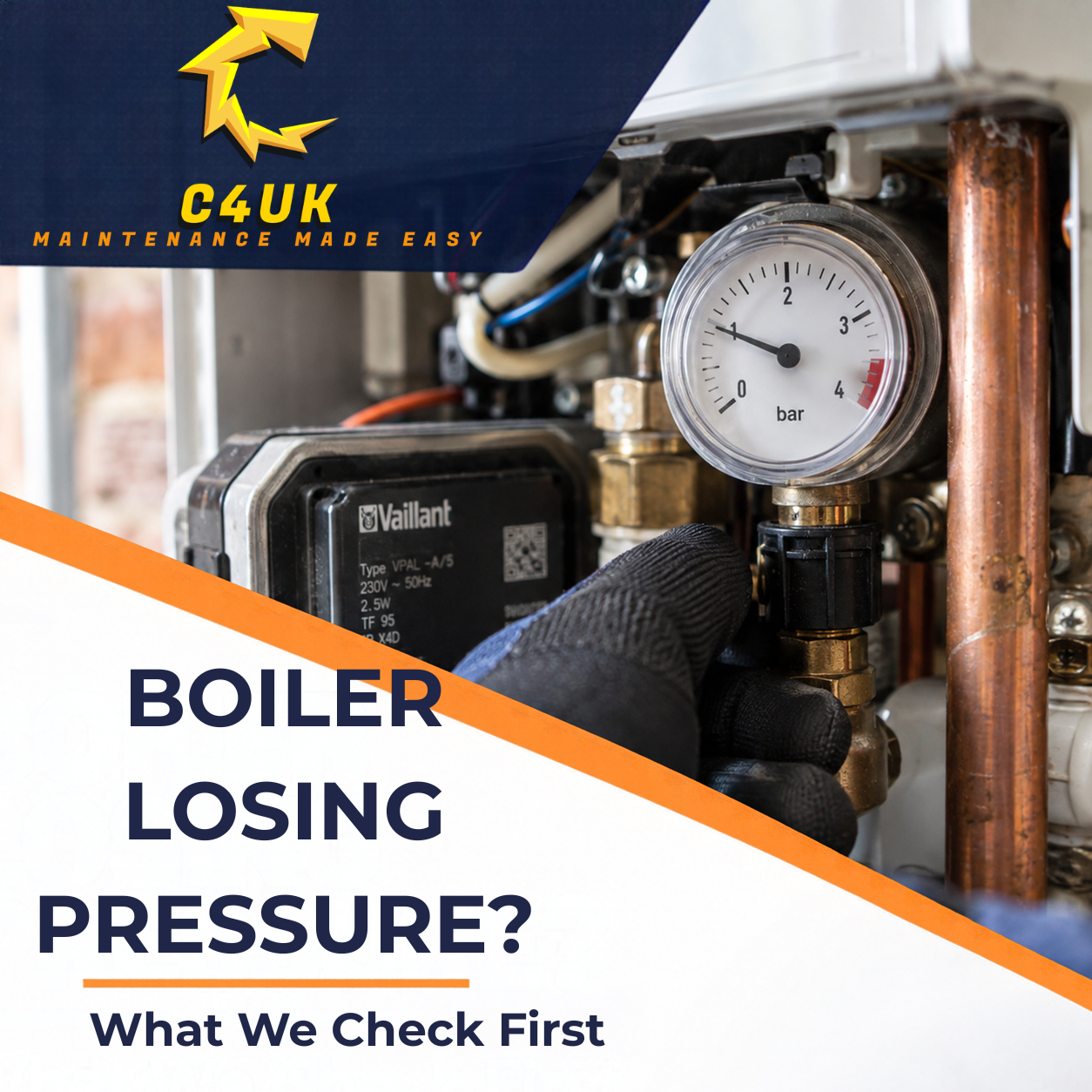
We regularly come across boilers losing pressure on repair jobs. A customer will often tell us they have been topping the boiler up every few days or weeks, but eventually the pressure drops again.
At that point, we don’t just keep refilling the system. We need to find out where that pressure is going and why.
Sometimes the problem is relatively straightforward, such as a leaking radiator valve. Other times, we need to investigate the Pressure Relief Valve (PRV), expansion vessel, hidden heating pipework, or components inside the boiler.
At Certificates4UK Ltd, we diagnose boiler pressure problems across Surrey, including West Molesey, Walton-on-Thames, Esher, Weybridge, Hersham and surrounding areas.
This guide explains the checks we typically make when investigating a boiler that keeps losing pressure.
What Pressure Should Your Boiler Be At?
The correct pressure depends on the boiler and heating system, so always follow the manufacturer’s instructions.
tic heating systems operate at approximately 1 to 1.5 bar when the system is cold.
When the heating comes on, the pressure will normally rise slightly as the water becomes hotter and expands.
That movement is normal.
What we’re interested in is a boiler where the pressure repeatedly drops below its normal operating range, and the homeowner has to keep topping it back up.
If you’re doing that regularly, there is usually a reason.
Why Does My Boiler Pressure Keep Dropping?
When we attend a boiler losing pressure call-out, we don’t immediately start changing boiler parts.
We work through the system logically.
Some of the main areas we investigate are:
- Leaks around radiators and valves
- Leaking heating pipework
- Hidden central heating leaks
- A passing Pressure Relief Valve (PRV)
- An expansion vessel problem
- Water leaking from components inside the boiler
- Unusual pressure behaviour between the heating and hot-water circuits
How quickly the pressure falls and what happens to the pressure when the heating gets hot can give us useful clues.
1. First, We Look for a Central Heating Leak
One of the first things we check is whether water is actually escaping from the heating system.
A central heating leak doesn’t have to leave a large puddle on the floor.
A small leak from a radiator valve or pipe fitting can be enough to gradually reduce the system pressure.
We normally look around:
- Radiator valves
- Radiator bleed points
- Towel radiators
- Visible heating pipework
- Pipe joints
- Areas around the boiler
- Accessible heating connections
We aren’t only looking for dripping water.
Sometimes you’ll see staining, corrosion, rust, or deposits around a fitting where a very small leak has been present for some time.
This is why physically inspecting the system is important.
What If There Is No Visible Leak?
This is where boiler pressure problems can become more difficult to diagnose.
Customers sometimes tell us:
“I’ve checked every radiator, and there isn’t a leak anywhere.”
They may be completely correct about everything they can see.
The problem is that a lot of central heating pipework isn’t visible.
Heating pipes may run:
- Under floorboards
- Under concrete or screed
- Behind walls
- Above ceilings
- Through boxed-in areas
So a property can have a central heating leak without there being an obvious puddle next to a radiator.
If the boiler and visible heating system appear dry but the pressure continues falling, hidden pipework may need further investigation.
Professional leak detection can sometimes help locate the affected area without immediately lifting large sections of flooring or opening walls unnecessarily.
2. We Check the PRV Discharge Pipe
Another important check is the Pressure Relief Valve (PRV).
The PRV is a safety component. If the pressure inside the heating system becomes too high, the valve can open and discharge water.
The discharge pipe normally terminates outside the property.
One of our simple checks is therefore to look at that pipe.
If it’s wet or dripping, we know water may be leaving the heating system through the PRV.
But there is another important question:
Why did the PRV open?
This is where correct diagnosis matters.
Changing a PRV without understanding why it has been discharging can mean the same problem comes back.
3. Then We Look at the Expansion Vessel
If the PRV has been discharging, one of the components we may investigate next is the expansion vessel.
The expansion vessel has an important job.
When the water inside your central heating system gets hot, it expands. The expansion vessel gives that additional volume somewhere to go while helping control the pressure within the sealed system.
If the vessel loses its charge or develops a fault, it may no longer do this properly.
This can create a very useful diagnostic clue.
Pressure Normal When Cold but Very High When Hot?
This is something we pay attention to.
For example, the boiler may start at a normal pressure when cold.
The heating comes on, and the pressure then climbs significantly.
The PRV may eventually discharge some water.
When the system cools again, the pressure can fall very low.
The customer then tops the boiler up again.
The same cycle repeats.
When we see this behaviour, the expansion vessel and PRV are obvious areas that need investigating.
Can You Just Recharge the Expansion Vessel?
Sometimes an expansion vessel can be recharged.
However, this depends on its condition.
If the vessel itself is still serviceable but has simply lost some of its gas charge, recharging may resolve the problem.
But we don’t assume every expansion vessel simply needs more pressure.
If the internal diaphragm has failed or the vessel cannot hold its charge, replacement may be necessary.
The correct approach is to test the vessel first and then decide what it needs.
4. We Check Whether the Boiler Itself Is Leaking
Sometimes the heating system outside the boiler is completely dry, but water is escaping from somewhere inside the appliance.
Depending on the boiler make and model, there are several possible places an engineer may need to investigate.
These can include:
- Hydraulic components
- Pump connections
- Automatic air vents
- Internal pipework
- Seals and O-rings
- Heat exchanger connections
- Diverter valve assemblies
This is where we move away from homeowner checks.
Do not remove the boiler casing yourself to look for a leak.
If you can see water underneath the boiler, staining around it, or another indication that water may be escaping internally, arrange for a suitably qualified engineer to inspect it.
5. What About the Plate Heat Exchanger?
This is an area where pressure faults can sometimes be misunderstood.
On a combi boiler, the plate heat exchanger allows heat to transfer between the boiler’s primary circuit and the domestic hot-water side while keeping the water circuits separate.
If an internal failure develops, water may potentially pass between circuits.
However, we wouldn’t diagnose a plate heat exchanger simply because somebody tells us:
“My boiler keeps losing pressure.”
The pressure behaviour needs to be properly investigated.
In fact, because domestic mains water pressure is often higher than the pressure inside the sealed heating circuit, some internal plate heat exchanger failures can cause the heating-system pressure to increase.
That’s why we look at what the boiler is actually doing rather than automatically replacing a part based on one symptom.
Where necessary, appropriate pressure testing can help identify what’s happening.
6. What About Using Leak Sealer?
We’re sometimes asked whether putting leak sealer into the heating system will solve a boiler pressure dropping problem.
Leak-sealing products can sometimes be used for very small heating-system leaks, particularly where access is difficult.
However, we don’t consider adding leak sealer to be a substitute for proper diagnosis.
If we can identify the actual leak and repair it correctly, that is generally the approach we prefer.
Before introducing any chemical treatment, the condition of the system, the boiler manufacturer’s requirements, and the suitability of the product should be considered.
A heavily contaminated heating system may also require professional cleaning or a power flush, depending on its condition.
7. Why We Don’t Recommend Constantly Topping Up the Boiler
This is probably one of the most important points in this article.
If you have to top up the boiler once after bleeding radiators or having work completed on the heating system, that doesn’t necessarily indicate a fault.
But if you’re doing it every few days or weeks, something isn’t right.
We regularly visit properties where customers are so used to repressurising their boiler that it has simply become part of their routine.
It shouldn’t be.
Every time significant amounts of fresh water are introduced into a sealed heating system, additional oxygen and minerals can enter the system.
Over time, this can contribute to corrosion and sludge formation.
More importantly, repeatedly topping up the boiler doesn’t fix whatever is causing the pressure loss.
You’re treating the symptom rather than the fault.
How We Diagnose a Boiler Losing Pressure
Every job is different, so there isn’t one test that diagnoses every pressure problem.
However, our investigation will usually start with the simplest and most likely areas before moving to more involved testing.
First, we look for visible leaks.
We check accessible radiators, valves, pipework, and areas around the boiler.
Next, we check the PRV discharge.
If water is leaving through the discharge pipe, we investigate why.
Then, we look at pressure behaviour.
What happens when the heating goes from cold to hot can tell us a lot.
A large pressure increase can point us towards the expansion vessel.
We check the expansion vessel and PRV where appropriate.
Rather than automatically replacing them, we determine whether they’re actually responsible for the fault.
If everything visible appears dry, we investigate further.
Hidden heating pipework or internal boiler components may then need to be considered.
This process is important because changing boiler parts without diagnosing the fault can quickly become expensive.
When Should You Call a Heating Engineer?
If the boiler has lost pressure once, that doesn’t necessarily mean you have a serious problem.
Repeated pressure loss is different.
We recommend arranging professional diagnosis if:
- You’re topping up the boiler regularly
- Pressure falls quickly after repressurising
- Pressure rises significantly when the heating gets hot
- Water is dripping from the PRV discharge pipe
- You suspect a hidden heating leak
- There is water underneath or around the boiler
- The boiler repeatedly stops because of low pressure
- You cannot work out where the pressure is going
If the pressure continues falling, the important question isn’t simply how to repressurise the boiler.
It’s why the boiler is losing pressure in the first place.
Boiler Repair Surrey: What We See on Real Jobs
At Certificates4UK Ltd, pressure problems are something our engineers regularly investigate as part of our boiler repair Surrey work.
Some are straightforward.
A leaking radiator valve or obvious PRV discharge can sometimes point us in the right direction quickly.
Other jobs take more investigation because the visible heating system is completely dry and the pressure loss is intermittent.
That’s why we prefer to diagnose the system in a logical order instead of replacing parts until the problem disappears.
Certificates4UK Ltd has been established since 2011, and we provide boiler repair and heating services across Surrey, including West Molesey, Walton-on-Thames, Esher, Weybridge, Hersham, Thames Ditton, Cobham and surrounding areas.
Frequently Asked Questions
Why is my boiler losing pressure but I can’t find a leak?
The absence of a visible leak doesn’t mean the system isn’t losing water. A leak may be beneath flooring, behind a wall, or somewhere else on hidden heating pipework. Water may also be escaping through the PRV discharge pipe or from a component within the boiler.
How often should I need to repressurise my boiler?
A healthy sealed heating system shouldn’t normally require constant topping up. You may occasionally need to adjust the pressure following radiator bleeding or maintenance, but repeated repressurising should be investigated.
Why does my boiler pressure rise when the heating comes on?
A small increase is normal because heating water expands. If the pressure rises significantly, an engineer may investigate the expansion vessel and other pressure-control components.
Why does the pressure go high when hot and low when cold?
One possible cause is an expansion vessel that isn’t accommodating the expanding heating water correctly. This can cause pressure to rise when hot and potentially result in the PRV discharging water. Once the system cools, the pressure can then be very low.
Can a leaking radiator cause boiler pressure to drop?
Yes. Water escaping from a radiator, radiator valve, bleed point or associated pipework reduces the amount of water within a sealed heating system and can cause the pressure to fall.
Can a boiler lose pressure without any visible water?
Yes. Small leaks and hidden pipework leaks aren’t always immediately visible. Water can also leave through the external PRV discharge pipe.
Can a plate heat exchanger cause pressure problems?
It can cause unusual pressure behaviour if there is an internal failure between circuits. However, this requires proper diagnosis because an internal plate heat exchanger problem can sometimes cause heating-system pressure to rise rather than fall.
Is it safe to keep topping up my boiler?
Occasional repressurisation can be normal after certain maintenance work. However, regularly topping up a boiler should not be treated as a permanent solution; if the pressure repeatedly falls, the underlying cause must be identified.
Can an expansion vessel be recharged?
Sometimes. If the vessel remains serviceable but has lost its charge, an engineer may be able to recharge it. If the internal diaphragm has failed or the vessel cannot maintain its charge, replacement may be required.
Related C4UK Guides
Boiler Breakdown: Causes, Prevention, and Finding the Best Boiler Repair Service Near You
Gas Safe Engineer: Why You Should Always Hire a Professional to Fix Your Boiler
Gas Safety Certificate Cost: Understanding Its Value and the Role of Power Flush Services
You should also link the phrase boiler repair Surrey within the article directly to your Boiler Repair page and power flush to your Power Flush service page.
Contact Certificates4UK Ltd
Need a reliable Gas Safe engineer for boiler repairs, safety checks, or certification? We’re here to help.
We cover:
Molesey • Walton • Woking • Cobham• Weybridge • Sunbury-on-Thames • Surrey • London
Before replacing any parts or booking costly work, let one of our qualified engineers carry out a professional inspection to save you time and money.
Booking Options:
- 🌐 Book Online – Simple, quick, and available 24/7
- 📞 Call: 07596 076700 or 07869 520044
- 📧 Email: info@certificates4uk.co.uk
📍 Proudly serving Molesey, Surrey, and London, we specialise in:
Boiler repairs, Gas Safety Certificates (CP12), Installation, plumbing, EICR testing, EPC inspections, and full property compliance.
⭐ Established in 2014, C4UK has been providing professional heating and property compliance services across Surrey and London. 160+ five-star reviews, Certificates4UK Ltd is the trusted choice for safe, professional, and cost-effective heating services.

Leave a Reply