
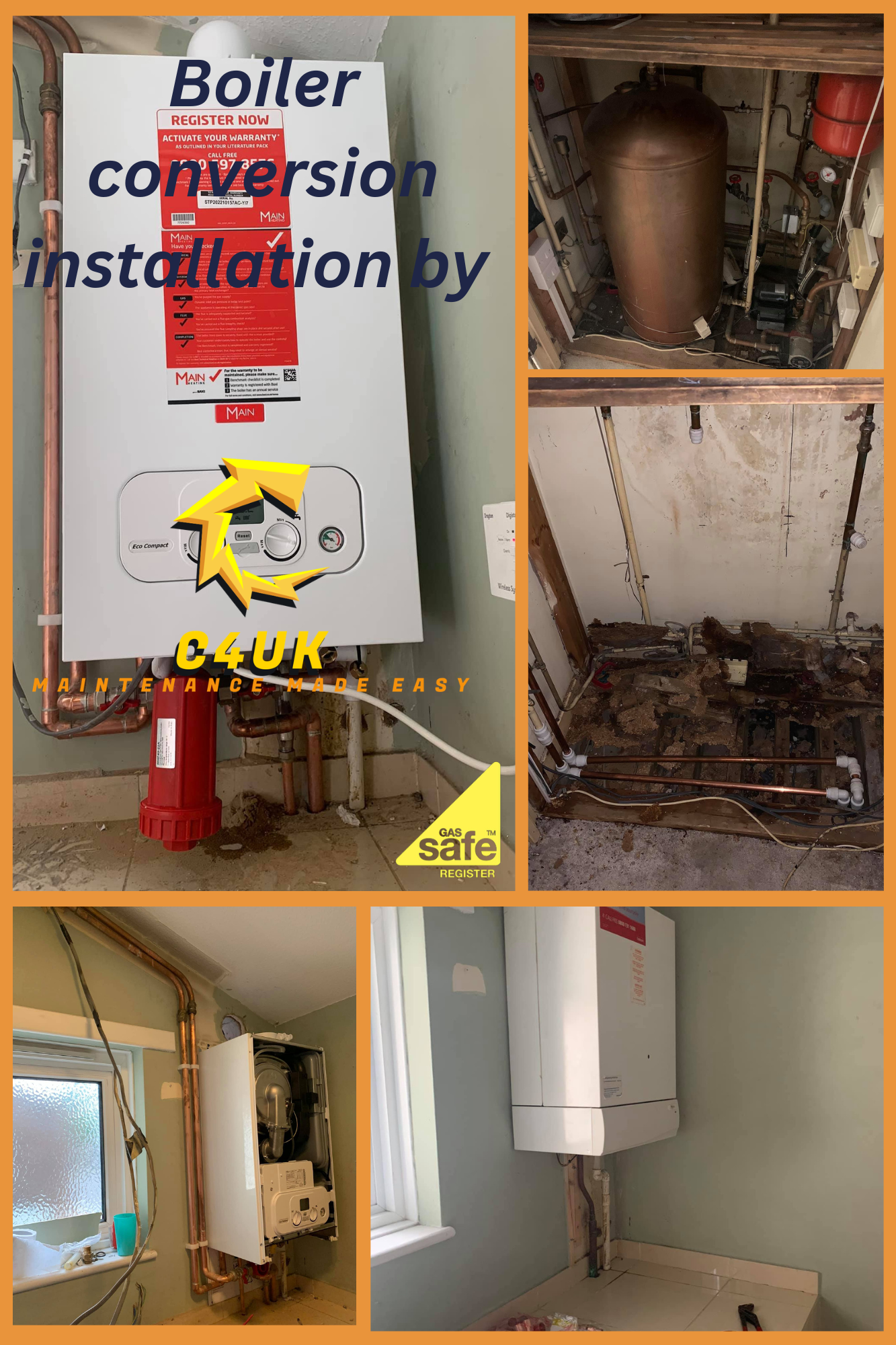
Converting a system boiler with a hot water cylinder to a combi boiler is one of the most common heating upgrades we carry out across Surrey, Kingston, Richmond, Wimbledon, Molesey, and Greater London.
However, many failed installations happen because incorrect pipework is left behind, especially 2-port motorised valves, cylinder circuits, and restricted heating loops.
This guide explains exactly what engineers must connect, remove, and reconfigure during a system-to-combi conversion, based on real installations carried out by Certificates4UK Ltd.
If you are planning a heating upgrade, you can also learn more about our boiler installation services in Surrey:
https://www.certificates4uk.co.uk/boiler-installation/

Original System Boiler and Cylinder Setup
Typical system boiler installation with hot water cylinder and motorised valves before conversion to a combi boiler.
System Boiler vs Combi Boiler – Engineer Overview
System Boiler
• External hot water cylinder
• Heating and hot water controlled by 2-port motorised valves
• Cylinder thermostat used for hot water control
• Boiler does not prioritise domestic hot water internally
Combi Boiler
• Instant hot water from the boiler
• Internal diverter valve
• Direct radiator circuit
• Direct cold mains water supply
⚠ Leaving any external restriction or valve in place can cause circulation faults and overheating problems.
Heating Circuit – Critical Installation Step
When converting to a combi boiler, the central heating flow and return must be direct.
There must be:
• No 2-port motorised valves
• No partially capped pipe tees
• No flow restrictions
If pipework is left incorrectly, engineers may encounter:
• Boiler overheating
• Pump noise
• Poor circulation
• Boiler lockout faults
Engineer rule:
If the pipe previously fed radiators, it must now form a continuous, unrestricted heating loop.
Direct Radiator Flow and Return
Combi boiler connected directly to radiator flow and return
Correct combi boiler installation with direct radiator circuit and no external control valves.
Cylinder Decommissioning
When a combi boiler is installed, the hot water cylinder becomes redundant.
Cylinder pipework includes:
• Coil flow and return
• Cylinder cold feed
• Hot water outlet
These pipes must either be:
• Safely capped
• Completely removed

Cylinder Removed
Cylinder removed and redundant pipework safely capped to prevent dead legs.
Remove: 2-port valve wiring Cylinder thermostat Boiler control becomes: Room thermostat Or OpenTherm / eBUS (if supported)
Leaving old wiring connected can cause: Permanent heat demand, Short cycling, Incorrect fault codes.
Pipework That Must Never Be Capped
The following pipework must never be restricted or capped during a conversion:
• Main heating flow
• Main heating return
• Safety discharge pipe
• Condensate pipe
• Expansion relief pipe
Mistakes here can lead to dangerous faults or failed safety inspections.
Electrical Changes During Conversion
When converting to a combi boiler, engineers must remove all system boiler control wiring.
Remove:
• 2-port valve wiring
• Cylinder thermostat wiring
Control systems then become:
• Room thermostat
• Smart thermostat
• OpenTherm or eBUS controls (if supported)
Leaving old wiring connected can cause:
• Permanent heat demand
• Short cycling
• Incorrect fault codes
Clean Wiring Centre
Heating wiring centre simplified for combi boiler installation.
All redundant system boiler wiring was removed to ensure correct combi boiler operation.
Engineer Checklist – System to Combi Conversion
Before completing the installation, engineers must confirm:
✔ Radiator circuit unrestricted
✔ All motorised valves removed
✔ Cylinder isolated or removed
✔ Cold mains pressure tested
✔ Heating system flushed or powerflushed
✔ Magnetic filter installed
✔ Expansion capacity checked
✔ Condensate pipe compliant
✔ Gas Safe commissioning completed
Gas safety guidance can also be found on the Gas Safe Register website:
https://www.gassaferegister.co.uk/
Why Flushing Matters
Combi boilers are less tolerant of dirty heating systems compared to system boilers.
If the existing system contains:
• Sludge
• Magnetite
• Microbore pipework
A power flush or chemical flush is strongly recommended.
Certificates4UK Ltd has completed 750+ power flushes across Surrey and London, helping restore circulation and protect new boiler installations.
Learn more about our power flush service here:
https://www.certificates4uk.co.uk/power-flush/
FAQ – System to Combi Boiler Conversion
Is converting to a combi boiler worth it?
For many homes, yes. Combi boilers remove the need for a hot water cylinder and can provide efficient heating and hot water from a single unit.
Do you remove the cylinder during conversion?
In most cases, the cylinder is removed, although pipework may be capped if removal is not required.
Does the heating pipework change?
Yes. The heating circuit must be converted to a direct flow and return system with no external motorised valves.
Contact Certificates4UK Ltd
Need a reliable Gas Safe engineer for boiler repairs, safety checks, or certification? We’re here to help.
We cover:
Molesey • Walton • Woking • Cobham• Weybridge • Sunbury-on-Thames • Surrey • London
Before replacing any parts or booking costly work, let one of our qualified engineers carry out a professional inspection to save you time and money.
Booking Options:
- 🌐 Book Online – Simple, quick, and available 24/7
- 📞 Call: 07596 076700 or 07869 520044
- 📧 Email: info@certificates4uk.co.uk
📍 Proudly serving Molesey, Surrey, and London, we specialise in:
Boiler repairs, Gas Safety Certificates (CP12), Installation, plumbing, EICR testing, EPC inspections, and full property compliance.
⭐ Established in 2014, C4UK has been providing professional heating and property compliance services across Surrey and London. 160+ five-star reviews, Certificates4UK Ltd is the trusted choice for safe, professional, and cost-effective heating services.

Leave a Reply